Agencies
- Deep Research
- Question in, cited Markdown report out.
- Company Profile Extractor
- Crawls company sites and extracts a profile. Reuses the same services.
Abdullah Siddiki Applied AI
Open to work · remote or NYC area (hybrid / in person)
 01MaktabSchool administration platform for Islamic schools. Admissions, Stripe tuition payments, academics and FERPA-audited student records.375API operations3,460automated tests23Stripe event types
 02Open Deep ResearchMulti-agent research API evaluated on 20 DeepResearch Bench tasks. The eval traced report quality to one reranking stage.0.847FACT accuracyr 0.69recall vs RACE$0.22median cost
 03jev-cc-analyzerAnswers 16 analyst questions about an earnings call with a decision model. Evaluated for accuracy, calibration and injection robustness.157 ms16 decisions91%acceptable vs gold0.10calibration error
 05candidsQR-code photo galleries for weddings and parties on an all-Cloudflare stack. Image moderation runs on a decision model picked by benchmark.0.866AUROC, Jev 1.1410,146images scored865tests
 06KhaldunMulti-agent equity research on Agno. Eight analyst agents feed a synthesizer, and a permission-aware chat answers over reports and team conversations.8analyst agents1typed LLM call each3chat sources
A multi-agent research API that turns one question into a long, cited report. I evaluated it on 20 DeepResearch Bench tasks with published graders, and the results traced report quality back to a single retrieval stage.
01Overview
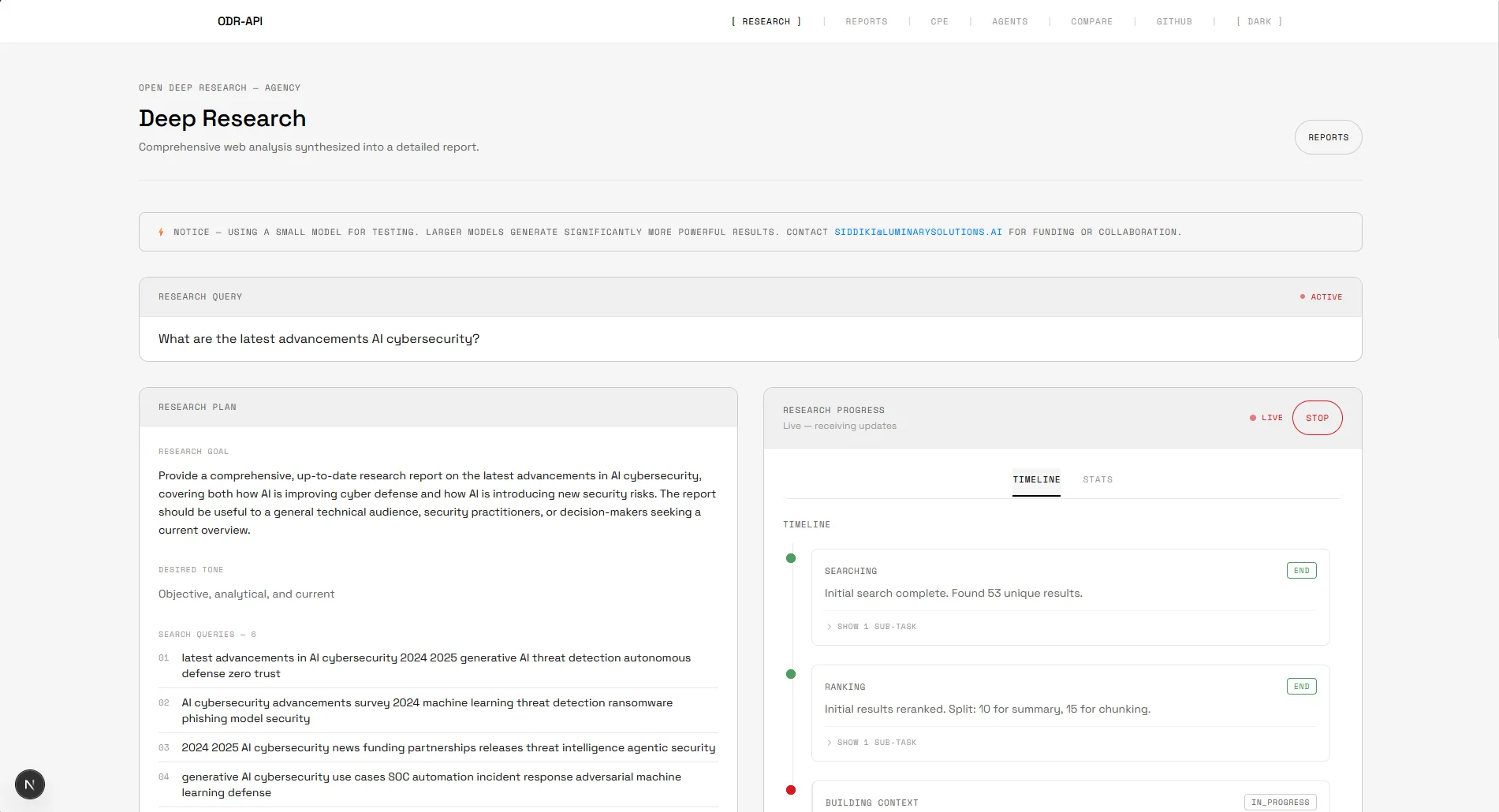
A client sends a research question over a WebSocket. Four typed agents and a set of shared services build the report while the server streams progress events. The code is organized as agencies built on shared services, so a second agency, a company profile extractor, reuses search, scraping and ranking.
Agencies
Agents
Services
Schemas
Every agent is a pydantic-ai agent with a typed output. Claude models use native JSON-schema structured outputs; any other model ID routes through OpenRouter, and each role can run a different model.
Runs are background tasks. If the socket drops, the run continues, state lands in Firestore, and the client polls for the result. A stop endpoint cancels the task.
{ step, status, message, details } · ~30 typed events
02System
Hover or tap a component to trace its connections. The flows step through a research run, the refine loop and an eval run. The eval harness calls the same orchestration function as the WebSocket route.
Hover or tap any component to trace its connections, or pick a flow to step through a request end to end.
03Pipeline
Red numerals mark steps that call a model. A task makes roughly 3 to 14 model calls: one plan, up to ten summaries, one draft and up to two refinements.
[ INITIALIZING ]
The server validates the query, assigns a task_id, writes PENDING then PROCESSING to Firestore and starts the run as an asyncio task.
[ PLANNING ]LLM
Sonnet 5.5 returns 3 to 7 SearchTasks, each with a query, an endpoint and a result count, plus a WritingPlan with ordered sections and guidance.
[ SEARCHING ]
One batched Serper call runs every sub-query. Results are flattened and de-duplicated by URL, about 59 per task in the baseline.
[ RANKING ]
Cohere scores each result’s title and snippet against the query and drops anything under 0.25. If the rerank call fails, the unranked list is kept.
[ PROCESSING ]
Kept URLs are scraped concurrently with one shared Chromium. PDFs are parsed with PyMuPDF and Wikipedia goes through its API.
[ PROCESSING ]LLM
Haiku 5.5 writes a dense summary of each top source, up to ten, keeping numbers, methods, findings and limitations.
[ PROCESSING ]
The remaining sources are chunked at 2,048 characters, reranked at 0.5, and the top five chunks per source are kept. Every source gets a stable reference number.
[ PROCESSING ]
tiktoken measures the context. Chunks are trimmed first if summaries and chunks together exceed 600,000 tokens.
[ WRITING ]LLM
Sonnet 5.5 drafts the report with [[CITATION:n]] on every claim. A validator raises ModelRetry if the draft has no citation markers.
[ REFINING ]LLM
If the writer requested searches, they run through the same retrieval path and the Refiner integrates only the new material. Two loops at most.
[ COMPLETE ]
Markers become [n], a numbered reference list is generated from the stable numbers, and the report streams with per-role token usage.
04Evals
Two evals, both built on published benchmarks. Judge prompts are copied verbatim from the upstream repositories; only the output-format lines are adapted to JSON-schema outputs, and every other deviation is listed with its reason.
◈ search_quality
Are the search results, the reranker’s ordering and the writer’s context relevant?
Method
An open reproduction of the LLM relevance assessor used for the TREC 2024 RAG track. Each passage gets a 0–3 grade, which feeds nDCG@10, precision@10, reranker recall and context precision.
What I changed, and why
Each passage gets two labels: one against the sub-query that retrieved it and one against the full task. UMBRELA expects a single focused query, and a result about one of three requested companies is a perfect hit for its sub-query but only related to the whole task.
castorini/umbrela
◈ report_quality
How good is the final report?
Method
DeepResearch Bench’s task-specific criteria, 22 to 28 per task with weights. The judge scores our report and the benchmark’s reference report on every criterion, and the result is ours / (ours + reference), so 0.5 means parity.
What I changed, and why
Both orders are scored and averaged to cancel position bias, and the gap is logged (mean 0.015). A per-task JSON schema forces the judge to return exactly that task’s criteria. Citation markers are stripped with a regex instead of an LLM pass.
Ayanami0730/deep_research_bench
◈ report_quality
Is each cited statement supported by the source it cites?
Method
Every statement–citation pair is checked by the judge. Citation accuracy is supported / (supported + unsupported).
What I changed, and why
Statements come from the structured citation markers, because upstream’s LLM extraction found 23 of 184 pairs in the pilot. Each claim gets its own call, because batching flipped 19 of 48 pilot verdicts. Claims are checked against the evidence the writer was given, which measures grounding in the pipeline’s own context.
DeepResearch Bench · FACT
05Baseline
Baseline configuration: Sonnet 5.5 for planner, writer and refiner, Haiku 5.5 for summaries, Cohere rerank at a 0.25 threshold, two refinement loops. 20 tasks, one repetition, no harness errors. Intervals are 95% normal approximations over tasks.
| Metric | Mean ± 95% CI |
|---|---|
| RACE overall | 0.365 ± 0.054 |
| Comprehensiveness | 0.337 ± 0.058 |
| Insight | 0.370 ± 0.057 |
| Instruction following | 0.360 ± 0.058 |
| Readability | 0.403 ± 0.049 |
| FACT citation accuracy | 0.847 ± 0.093 |
| Supported citations per report | 87.4 ± 21.8 |
| Metric | Mean ± 95% CI |
|---|---|
| Reranker nDCG@10 | 0.578 ± 0.112 |
| Reranker precision@10 | 0.470 ± 0.129 |
| Reranker recall | 0.426 ± 0.149 |
| SERP precision | 0.344 ± 0.071 |
| Context precision | 0.376 ± 0.135 |
| Task-level nDCG@10 | 0.655 ± 0.119 |
2 / 20
Reports judged better than the reference (0.534, 0.514)
1,748
Supported citations of 2,223 statement–citation pairs
2,805
Median words per report. References run 5k–15k
$25.68
Whole baseline: $5.64 pipeline, $20.04 grading
Task 75 produced no report and scored 0. It stays in the averages, because a run that writes nothing is a product failure. Pipeline cost per task ranged from $0.03 to $1.03 and time from 21 to 1,040 seconds. Grading cost about 3.5 times as much as running the pipeline.
06Finding
Report quality follows reranker recall (r = 0.69). On half the tasks the reranker kept 8 or fewer of about 60 results, and those tasks scored far lower.
Report quality tracks how much evidence survives the reranker
RACE vs reranker recall, one point per task · Pearson r = 0.69 · n = 20
10 / 20
Tasks where the reranker kept 8 or fewer results
16% · 70%
Relevant results kept: starved tasks · the rest
0.280 · 0.449
RACE: starved tasks · the rest
0 / 57
Results kept on task 75, which wrote no report
Correlation with RACE
Pearson r across the 20 baseline tasks. Retrieval-volume signals highlighted.
The cause. DeepResearch Bench prompts are long and multi-part. The reranker scored each result against the whole prompt, so relevant results got low absolute scores and the fixed 0.25 threshold discarded them.
Search was fine. SERP precision barely correlates with quality (r = 0.12), and neither does context precision (r = 0.05). The writer’s context was precise enough. The constraint was how much relevant evidence reached it.
Grounding held. FACT stayed high on starved tasks: 0.967 on task 53 and 1.000 on task 59. Task 53’s report opens by noting that it rests on a single source. The low RACE on those tasks reflects missing coverage.
Refinement did not recover them. Refinement searches go through the same reranker and threshold, so their results were filtered the same way.
07Harness
The harness is built so results stay comparable while the pipeline changes underneath it.
[ GATE ]
SHA-256 over graders, prompts, runner, sanity checks, data and uv.lock. Every script exits with code 2 until a human re-approves the digest, so no one, including the coding agent doing the hill-climbing, can edit the grader between variants.
[ CACHE ]
UMBRELA labels are keyed by sha256(version | model | query | passage). Variants pay only for unseen passages, and identical passages always get identical labels.
[ FAILURES ]
Timeouts, pipeline errors and served-model mismatches are harness errors and are never scored. A run with no context or a failed writer is a product failure and scores 0. Judge errors are typed: refusal, truncated, unparseable, api_error.
[ MODEL ]
The served model is read from every agent result and compared with the requested one, so a server-side fallback cannot silently swap models mid-eval.
[ SANITY ]
Known inputs run through the real graders before a paid pass: an on-topic passage must score 3, the reference against itself must land in 0.42–0.58, an empty article must score under 0.15.
[ COST ]
Every call is priced from a per-model table, including cache reads and writes. An unknown model raises KeyError, so a silent $0 cannot reach a report.
[ PILOT ]
Two tasks ran first, with a written review of graded examples and judge reasoning. The full run started after sign-off.
[ RESUME ]
Pipeline, search grading and report grading are keyed per (task, rep). A restart skips finished work in all three.
08Iteration
v1 reranks each result against the sub-query that retrieved it, keeps at least three results per sub-query, and merges the kept lists round-robin so every aspect of the question is represented. One flag restores the baseline.
# False restores the 2026-10-23 eval baseline
rerank_against_subquery: bool = True
rerank_min_results_per_query: int = 3
The change applies to initial results, to chunks, and to results from refinement searches. Its docstring cites the eval directly: the search eval measured 43% reranker recall.
It was piloted first on the two most-starved tasks. The runs are complete but have not been graded yet, so the table shows only what the pipeline logged.
| Run | Results kept | Sources | Words | Time | Cost |
|---|---|---|---|---|---|
| Task 53 · baseline | 1 / 64 | 1 | 1,828 | 89 s | $0.11 |
| Task 53 · v1 | 41 / 59 | 17 | 3,434 | 449 s | $0.31 |
| Task 75 · baseline | 0 / 57 | 0 | no report | 21 s | $0.03 |
| Task 75 · v1 | 50 / 62 | 29 | 5,132 | 684 s | $0.60 |
The pilot moved the bottleneck. More evidence now reaches the writer, and summaries run one source at a time, so summarizer input on task 53 rose from 71,683 to 434,942 tokens and wall time grew fivefold. Next: grade v1 on all 20 tasks (cached labels make the search grading cheap), run two repetitions to tighten the intervals, and parallelize summarization.
09Trade-offs
ADR 01
Summaries carry the most useful sources in dense form; chunk reranking covers the long tail cheaply.
Trade-off Summaries run sequentially, which sets most of the latency. The v1 pilot made this visible.
ADR 02
References render deterministically, and the FACT eval can extract every statement–citation pair without an LLM.
Trade-off The writer has to comply. A validator enforces it with retries.
ADR 03
Tokens per loop stay bounded and the loop count is capped.
Trade-off The refiner cannot revisit evidence it was not shown in that loop.
ADR 04
Common LLM mistakes, like echoing the endpoint list or an out-of-range count, are coerced into valid values.
Trade-off Validators encode assumptions about which mistakes are safe to repair.
ADR 05
Research runs take minutes. A dropped connection should not cost the run.
Trade-off The task registry is in process memory, so cancel only reaches the instance that owns the task.
ADR 06
The prompts and criteria were not written by me, scores are comparable with other systems, and the method is documented.
Trade-off References are 5k to 15k words against reports of about 2.8k, which caps comprehensiveness.
10History
Apr 2025
One 1,201-line DeepResearchAgent class on a LiteLLM wrapper. Together AI reranking, inline XML tags for search requests, context trimmed by character count.
Apr 2025
Agencies, services and core layers. Typed requested_searches replaced the XML tags. WebSocket callbacks, Firestore and Docker followed in the same week.
Apr–Aug 2025
A company profile extractor with its own planner and extractor agents, reusing search, scraping and an email finder.
Apr 2026
uv with a lockfile, Cohere rerank as default, a non-root Docker image with a cached Playwright layer, and the frontend moved to the Nothing design system.
Oct 2026
Native Claude structured outputs, trace instrumentation, explicit rerank failure semantics, the eval harness and baseline, and the v1 retrieval change.
11Reliability
What breaks, what guards it, and where it shows up.
| What breaks | Guard | How I'd know |
|---|---|---|
| Rerank API down | The rerank call raises instead of returning an empty list. Results fall back to unranked; a chunk-rerank outage keeps the source’s chunks. | RANKING warning events in the stream. |
| Nothing survives rerank | Scored as a product failure and kept in the averages. v1 adds a floor of three results per sub-query. | no_context in the eval; task 75 in the baseline. |
| Draft without citations | Output validator raises ModelRetry; three validator retries inside three orchestrator retries. | Zero citation markers in the FACT extraction. |
| Silent model fallback | Served model compared with the requested one on every agent result. | model_mismatch in errors.jsonl; never scored. |
| Client disconnects | The run keeps going as a background task; the client polls REST; stop cancels. | Firestore status and the result endpoint. |
| Judge flakes | Up to six attempts with jittered backoff, Retry-After honoured, explicit handling of 529s and dropped streams. | Typed JudgeError per case. |
| Grader drifts during tuning | Hash gate over graders, prompts, data and uv.lock. | Scripts exit with code 2 until re-approved. |
12Stack
API
Agents
Planner, writer and refiner on Sonnet 5.5, summarizer on Haiku 5.5 in the eval baseline. Every role is configurable.
Retrieval
Streaming · state
Frontend
Nothing design system: Doto, Space Grotesk, Space Mono, one red accent.
Evals
Deploy